Farreach International’s Theory of Change
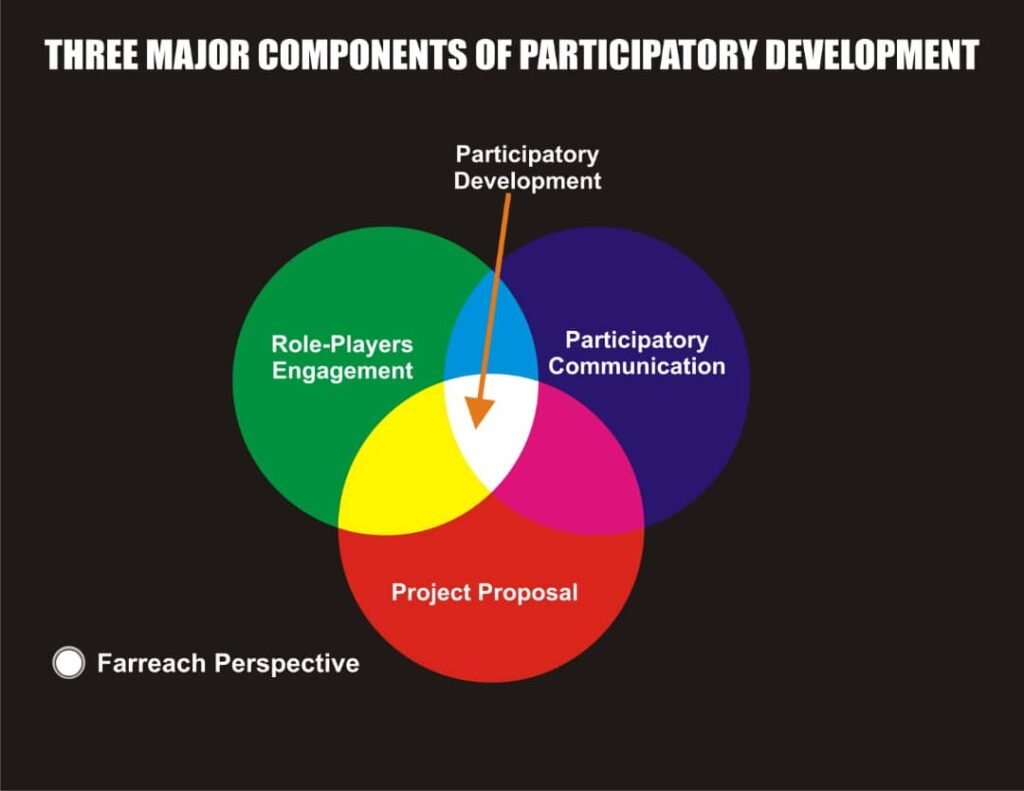
Farreach International – Theory of Change
Core Premise
Farreach International’s Theory of Change is grounded in a simple but transformative proposition:
Development outcomes improve when communication is participatory, power is shared, and communities are positioned as co-producers of change rather than passive recipients of intervention.
When development processes are designed with—not merely for—people, they generate stronger ownership, adaptive learning, institutional trust, and long-term sustainability.
The Problem We Seek to Change
Across sectors and regions, development initiatives frequently underperform not because of insufficient resources or technical expertise, but because of process failures:
- Communication is treated as an add-on rather than a core design function
- Community engagement is symbolic, extractive, or episodic
- Feedback mechanisms are weak or absent
- Institutions lack structured ways to listen, adapt, and respond
- Knowledge generated by communities is rarely translated into decision-making
These dynamics produce interventions that may deliver outputs, but fail to embed legitimacy, learning, or durability.
Farreach International’s Change Pathway
Farreach International addresses this challenge by intervening at the level of development practice itself—shaping how development is conceptualized, designed, implemented, and learned from.
Our Theory of Change unfolds across five interconnected layers:
- If Communication Is Repositioned as a Core Development Function
Farreach International advances the Farreach Theory, which conceptualizes communication as:
- Iterative rather than linear
- Dialogic rather than transmissive
- Relational rather than instrumental
By reframing communication as a constitutive element of development, we enable practitioners and institutions to design interventions that are responsive, ethical, and grounded in lived realities.
- If Practitioners and Institutions Are Equipped with Practical Participatory Tools
Through the FarreachOne Toolkit and related learning platforms, Farreach translates theory into structured, adaptable, field-ready methods.
When practitioners have access to clear participatory tools:
- Community engagement becomes systematic rather than ad hoc
- Power dynamics are made visible and negotiable
- Local knowledge is documented and integrated into planning
- Feedback becomes continuous, not post hoc
This shifts development from rigid project execution toward adaptive co-creation.
- If Communities Are Engaged as Knowledge Holders and Co-Designers
Farreach-supported processes enable communities to:
- Articulate priorities in their own terms
- Shape intervention logic and implementation pathways
- Participate in monitoring, reflection, and course correction
When communities are engaged as partners, development initiatives gain:
- Stronger legitimacy and trust
- Higher relevance and cultural fit
- Increased local ownership and sustainability
This is where development begins to endure beyond project cycles.
- If Institutions Strengthen Accountability and Learning Systems
Farreach International embeds participatory feedback, monitoring, and learning mechanisms that:
- Improve institutional responsiveness
- Support evidence-informed adaptation
- Strengthen transparency and mutual accountability
As institutions learn to listen, respond, and adapt, relationships between communities and development actors shift from extraction to collaboration.
- Then Development Outcomes Become More Sustainable, Equitable, and Scalable
When communication is participatory, tools are practical, communities are co-creators, and institutions are accountable:
- Development interventions are more effective and contextually appropriate
- Behavioural and social change is more likely to be sustained
- Governance processes become more inclusive and trusted
- Development systems become more resilient and learning-oriented
Over time, these shifts contribute to field-level transformation, influencing how development is practiced across sectors and regions.
Long-Term Impact
Farreach International contributes to a future in which:
- Development is co-produced rather than imposed
- Communication is integral, not peripheral
- Communities are recognized as agents of change
- Institutions are accountable, adaptive, and trusted
- Development practice is ethically grounded and practically effective
This is development that reaches further—not only geographically, but socially, institutionally, and generationally.
What Makes Farreach International Distinct
Farreach International’s Theory of Change is distinctive because it:
- Bridges academic theory and operational practice
- Focuses on process quality as a driver of outcomes
- Invests in field-building, not just projects
- Treats participation as a design principle, not a checkbox
In Summary
If development actors rethink communication,
and if they are equipped with participatory tools,
and if communities are engaged as co-producers,
then development interventions become more legitimate, adaptive, and sustainable—
leading to lasting social change and stronger development systems worldwide.