Introduction
Farreach Theory emerged from my desire to create and define a framework capable of producing a paradigm shift in the theory and practice of International Development, Development Communication, and Development Studies in Africa. It was also conceived to provide a guiding framework for the operations of Farreach International and the Farreach Initiative for Development Communication in Africa.
The idea of Farreach Theory was conceived in 2007, immediately after I completed my first degree, when I had the opportunity to work as an ad hoc field staff member with the Imo State Economic Planning Commission. The Commission was conducting a statewide survey of abandoned, uncompleted, functioning, and non-functioning development projects, particularly infrastructural projects, across Imo State, Nigeria.
At the time, the Governor of Imo State, Chief Dr Ikedi Ohakim (2007–2011), initiated the survey to assess the condition of development projects funded by local governments, the state government, the federal government, and international donor agencies. Two ad hoc field workers were assigned to each autonomous community. I was assigned to my community, Umuaka, in the Njaba Local Government Area of Imo State.
My colleague, who came from another village in Umuaka, and I met with the traditional rulers and the President-General of the Umuaka Development Union. They guided us through the various development projects within the community. We visited project sites, interacted with community members, and gathered information about the projects. We completed the survey forms, submitted our reports to the Commission, and were subsequently paid for our services.
However, the experience left a far deeper impact on me than I could have imagined.
From that survey experience, two inspired ideas became deeply rooted in my mind. The experience opened my eyes to view development projects from an entirely different perspective.
My observations at various project sites, the discussions I had with community members, and the stories they shared with me prompted me to reflect deeply on why some development projects succeed while others fail.
The most important lesson I drew from that experience was that development projects—especially participatory development projects—rest on three major pillars:
- People (Role-Players)
- Project
- Communication
I came to believe that the intersection of these three pillars largely determines the success or failure of any participatory development project.
The first inspired idea was to write a novel titled Shadows of Development, for which I began the first draft in 2009.
The second inspired idea was to explore a research question centred on the intersection of these three pillars of participatory development. At the time, however, I felt I needed more intellectual maturity, practical experience, and deeper reflection before embarking on such a study.
In August 2007, I left home for my one-year National Youth Service Corps (NYSC) programme in Kogi State, North-Central Nigeria.
During my NYSC year, I applied for admission to study International Business and Marketing at a university in Sweden. I was offered admission and subsequently applied for a student visa. Unfortunately, my visa application was denied because the proof of funds I submitted was considered insufficient.
After completing my NYSC programme in 2008, I returned to Imo State and resumed my fashion design business, which I had started as an undergraduate. The business specialised in the production and sale of native and corporate clothing for men. At the same time, I continued searching for a white-collar job.
In January 2009, I relocated to Aba, which served as the centre of my fashion business operations. From there, I expanded my business network into Port Harcourt in Rivers State and Yenagoa in Bayelsa State, significantly increasing my client base.
By 2010, my business had grown sufficiently to support both my living expenses and further education. Consequently, I enrolled in a graduate programme in Management at the University of Port Harcourt. I intended to specialise in Strategic Management or Corporate Communication, with the long-term goal of pursuing an academic career or establishing a private research and consultancy firm after completing doctoral studies.
Yet something continued to trouble me.
Whenever I travelled home and passed by any of the development projects I had visited during the 2007 survey exercise, I found it difficult to sleep. The memories of those sites, the conditions of the projects, and the stories people shared with me lingered in my mind.
At one point, I deliberately avoided travelling through some of the roads where those projects were located because of the emotional burden they carried for me.
The experiences, observations, and unanswered questions from that survey continued to resonate within me. They gradually drew my interest toward Development Studies, Project Management, and Development Communication as I sought to understand what was happening within the international development sector and why so many interventions struggled to achieve sustainable outcomes.
Graduate Studies, Career Challenges, and the Birth of Farreach Media (2010–2016)
In 2012, after completing my postgraduate programme in Management, I enrolled in a Master’s degree programme in Communication Studies at the University of Port Harcourt. Pursuing graduate studies while managing a growing fashion design business in Aba was not easy.
The demands of my studies often kept me away from my clients. As a result, some customers took advantage of my absence to delay payments for clothes I had supplied or avoid settling outstanding debts. Gradually, the volume of bad debts increased and began to affect both my business and my academic progress.
By the 2014/2015 academic session, the financial strain had become severe. I was unable to complete the payment of my school fees and, consequently, could not participate in the external defence of my Master’s thesis.
Determined to overcome the challenge, I accepted a position as Assistant Manager (Sales and Marketing) with a confectionery company in Aba. My objective was simple: raise funds to complete my studies.
While working there, I saw an opportunity to apply some of the knowledge and skills I had acquired through my studies. Within four months, I initiated and conducted an applied research project on the impact of communication in relationship-oriented marketing. After completing the study, I submitted the research report to the company’s Chief Executive Officer.
The findings and recommendations from the study significantly improved the company’s sales performance and revenue generation over the following three months.
Despite the success of the project, I found little satisfaction in the job. The work environment was toxic, and I could not see a future there. After six months, I resigned and relocated to Port Harcourt.
At that stage of my life, I was no longer searching merely for employment. I was searching for mentorship.
I wanted to learn directly from experienced researchers and consultants. I desired practical exposure to the consulting profession and hoped to find a private consultancy firm where I could develop professionally under the guidance of seasoned practitioners.
For nearly six months, I attended monthly meetings of the Nigerian Institute of Public Relations (NIPR) and the Nigerian Institute of Management (NIM), Rivers State Chapter. I networked extensively, hoping to meet a mentor or identify a consultancy firm willing to take me in.
Unfortunately, none of my efforts produced the desired result.
During this period, I met a member of the NIPR who was also the Editor-in-Chief and publisher of a local newspaper known as Notable Outcomes. After listening to my story, he encouraged me to continue visiting his office while I pursued my search for a consultancy opportunity.
I accepted his invitation.
Soon, I began contributing articles to the newspaper. Through that experience, I developed a growing interest in printing and publishing and started learning the business.
In August 2015, I travelled to Owerri to explore opportunities in the printing and publishing industry and to investigate whether I could locate a consultancy firm there.
Providence smiled on me.
While making enquiries at a local newspaper office, I met one of the editors. After a brief conversation, he introduced me to the publisher. Following our discussion, she immediately invited me to join the editorial team as a reporter and sub-editor. To my surprise, she assigned me to cover a political event in Owerri that very day.
I accepted the opportunity and joined the newspaper’s editorial team.
At the same time, I intensified my efforts to meet the Chief Executive Officer of a consultancy firm I had identified in Owerri.
In October 2015, I finally met Dr Chuks Osuji, Chief Executive Officer and Lead Consultant of Opinion Research and Communications, Inc., Owerri.
Our meeting proved to be one of the defining moments of my early professional journey.
After listening to me, Dr Osuji explained that he was not recruiting and had no immediate plans to engage a new consultant. However, he made an offer that would have a profound impact on my future.
He offered me an office space within his office complex where I could work independently. He also promised to engage me whenever opportunities arose that matched my skills and interests.
To many people, an office space might have seemed like a small gesture.
To me, it was a priceless gift.
It represented encouragement, validation, and an opportunity to begin building a career as a researcher and consultant.
From that day, I began going to my office regularly with my laptop, conducting research, writing, learning, and gradually developing my professional identity. At the same time, I continued contributing occasionally to local newspapers.
By this period, my plans to pursue doctoral studies had been placed on hold because of the financial difficulties I had experienced in my fashion business. Yet, despite the uncertainty, I found myself standing at a crossroads.
I had to decide whether to return fully to business as usual or pursue a path that aligned with my deepest passion.
My heart had already made its choice.
Research, consulting, communication, and development work brought me a sense of purpose and fulfilment that I could not ignore. The fashion business had served its purpose in my life, but my passion was leading me elsewhere.
Naturally, many voices around me questioned my decision. Some considered it unrealistic. Others believed I was embarking on what could only be described as a suicide mission.
From a practical perspective, their concerns were understandable.
The facts available at the time seemed to support their arguments.
Yet, amidst all the noise, I consistently heard a quiet and gentle voice urging me to move forward. Whenever I listened to that voice, I experienced peace and joy.
As a Christian, I recognised that voice.
It gave me the courage to continue.
In August 2015, I made a firm decision to pursue the path before me. I sought and received the blessing of my parents to begin a new venture.
Thereafter, I initiated the process of registering a new company.
In January 2016, Farreach Media was officially registered.
The company began by providing printing and publishing services, alongside media and communication solutions, to individuals, churches, and small business organisations.
At the same time, I continued to learn from my association with Dr Chuks Osuji. I had the privilege of working with him on various assignments involving book writing and publishing, communication research, public relations consultancy, communication design, and implementation projects.
Those experiences became part of the foundation upon which Farreach would eventually be built.
Although I did not fully realise it then, the pieces of a much larger vision were gradually coming together.
The Establishment of Farreach Initiative and the Beginning of Farreach Theory (2017–2020)
In January 2017, I rented an office space for Farreach Media and registered the Farreach Initiative for Development Communication in Africa, Inc., as a non-governmental organisation. The purpose of the organisation was to promote inclusive and innovative solutions that would facilitate and drive sustainable development initiatives in rural and urban communities across Nigeria.
From the beginning, I was determined that the organisation would take a different approach from many development organisations operating around us.
The experience I had during the 2007 survey of development projects in Imo State remained deeply alive in my mind. The questions that emerged from that experience had never left me. Why do some development projects succeed while others fail? Why do communities reject projects designed to benefit them? Why do development interventions often struggle to achieve sustainable impact despite significant investments of time, expertise, and financial resources?
More importantly, what was missing?
The desire to answer these questions compelled me to revisit the second inspired idea that had come to me in 2007—the idea of exploring the intersection of the three pillars of participatory development: People, Communication, and Project.
By 2017, I felt prepared to undertake that challenge.
I began working deliberately on a research programme aimed at creating and defining a framework that could contribute to a paradigm shift in Development Communication, Development Studies, and International Development practice in Africa and beyond.
At the same time, I wanted the framework to serve as the intellectual foundation for the work of the Farreach Initiative for Development Communication in Africa and, later, Farreach International Ltd., the research and consultancy firm I registered in 2020.
As I immersed myself in the literature, I quickly realised that I was not alone in asking questions about the effectiveness of development interventions.
The works of distinguished scholars such as Robert Chambers, Paulo Freire, Jan Servaes, Thomas Tufte, Paolo Mefalopulos, Alfonso Gumucio Dagron, and many others revealed that similar concerns had occupied the minds of researchers and practitioners for decades.
Their contributions profoundly influenced the development of Farreach Theory.
As I studied their work, I became increasingly convinced that participatory development rests upon three fundamental pillars:
- People (Role-Players)
- Communication
- Project
Each pillar contains its own challenges, debates, and areas of scholarly inquiry.
Within the People pillar, I observed recurring issues relating to power, representation, participation, ownership, and decision-making. Scholars such as Robert Chambers demonstrated how development interventions often reflect the interests and priorities of governments, donor agencies, and external actors while unintentionally marginalising the voices of those they are intended to serve.
This insight reinforced a conviction that had been growing within me since 2007: the core beneficiaries of development interventions must occupy a central position in participatory development.
Without them, development efforts lose their direction and purpose.
If development interventions genuinely exist to improve people’s lives, then the people whose lives are affected must be placed at the centre of the process.
Consequently, I came to view the core beneficiaries of development interventions as the foundation of the People pillar.
My exploration of the Project pillar revealed another set of challenges. Across numerous studies and project evaluations, issues such as corruption, misappropriation of funds, weak implementation structures, inadequate monitoring systems, and ineffective evaluation mechanisms appeared repeatedly.
However, my background in management and project management led me to focus on a more fundamental element.
Every development intervention begins with a project proposal.
The proposal serves as the roadmap that guides implementation, resource allocation, stakeholder engagement, monitoring, evaluation, and sustainability planning.
Without a project proposal, there is no structured intervention to implement.
For this reason, I concluded that the project proposal constitutes the foundation of the Project pillar.
The third pillar, Communication, presented perhaps the most fascinating intellectual challenge.
Through the works of Jan Servaes, Thomas Tufte, Paolo Mefalopulos, Alfonso Gumucio Dagron, and others, I encountered extensive debates regarding communication models, development communication approaches, communication for social change, behavioural change communication, strategic communication, public relations, social mobilisation, and participatory communication.
One observation became increasingly clear.
Development practitioners and communication professionals often draw from different communication traditions and frameworks when implementing development interventions. While these approaches may offer valuable insights, their diversity can also create confusion regarding which communication model is most appropriate for participatory development.
This challenge has been noted by several scholars, including Everett Rogers and Jan Servaes.
As I examined these perspectives, I became convinced that participatory communication occupies a uniquely important position within development interventions because it facilitates meaningful engagement among role-players, particularly the core beneficiaries.
Participatory communication enables listening, dialogue, consultation, feedback, negotiation, collaboration, and collective ownership of development processes.
For this reason, I concluded that participatory communication forms the foundation of the Communication pillar.
As my research progressed, I made another important observation.
Although many scholars had examined individual aspects of participatory development, I could not find a comprehensive framework that clearly explained the relationship and interaction among these three foundational pillars: People, Communication, and Project.
The literature offered valuable insights into each component separately, but there appeared to be a gap regarding how these components intersect and influence one another within participatory development interventions.
That observation became one of the principal motivations for developing Farreach Theory.
The task before me was no longer to study development interventions.
The task was to develop a framework that explains how effective participatory communication, meaningful role-player engagement, and a well-designed project proposal interact to produce far-reaching and sustainable development outcomes, and improve impacts.
That challenge marked the true beginning of the Farreach Theory journey.
The Presuppositions and Beliefs of Farreach Theory
As I continued developing the Farreach Theory, I discovered that every theory is built upon certain assumptions, observations, and beliefs about reality. Farreach Theory is no exception.
The theory emerged from my personal experiences, extensive literature review, professional observations, and reflection on the successes and failures of participatory development interventions in Africa and beyond.
My studies of development communication, participatory development, project management, and international development gradually led me to several foundational conclusions.
First, I became convinced that the core beneficiaries of development interventions occupy the most important position within participatory development. Development interventions are ultimately designed to improve the lives and well-being of people. Therefore, without the existence of the core beneficiaries, the efforts of governments, donor agencies, development practitioners, communication specialists, consultants, and other stakeholders lose their purpose and direction.
Second, I became convinced that a project proposal is more than a funding document. It is the roadmap that guides every development intervention. It provides direction, establishes priorities, defines objectives, allocates resources, and determines how implementation, monitoring, evaluation, and sustainability will be pursued.
Third, I became convinced that participatory communication is the most effective means of engaging role-players throughout the life cycle of a participatory development intervention. Through participatory communication, voices are heard, concerns are identified, relationships are strengthened, and collective ownership of development processes becomes possible.
These observations gradually evolved into the foundational presuppositions of Farreach Theory.
Farreach Theory postulates that participatory communication, role-player engagement, and project proposal are the three major components of participatory development.
The theory provides a framework for understanding the intersection of these three components and their influence on the success or failure of development interventions. It seeks to fill a gap in the existing literature by explaining how effective participatory communication, meaningful role-player engagement, and a well-designed project proposal work together to generate far-reaching and sustainable development outcomes.
The central thrust of Farreach Theory is the effective incorporation and implementation of the principles of participatory communication and role-player engagement within a project proposal designed to facilitate development interventions in Africa and beyond (Dikeocha, 2024).
Farreach Theory is anchored on the following premises:
Participation is an Inclusive Process
Participation is not merely the presence of people at meetings, consultations, workshops, or project activities. True participation is an inclusive process that deliberately creates opportunities for all relevant role-players to contribute meaningfully to decisions that affect them.
Farreach Theory therefore views participation as a continuous process of engagement rather than a single event within a project cycle.
The Core Beneficiaries Must Be Put First
The popular saying that “he who wears the shoe knows where it pinches most” captures one of the central beliefs of Farreach Theory.
The experiences, realities, challenges, and aspirations of the core beneficiaries of development interventions cannot be ignored when designing solutions to their problems. Because they live with these realities daily, they are often in the best position to identify challenges, prioritise needs, and contribute valuable insights towards finding sustainable solutions.
Their voices, opinions, and perspectives should therefore count significantly throughout the development process.
Role-Players’ Opinions Are Not Static
Farreach Theory recognises that the opinions, interests, expectations, and consent of role-players are dynamic rather than fixed.
The priorities of communities may change. New stakeholders may emerge. Existing stakeholders may adjust their positions in response to changing circumstances.
Consequently, relying exclusively on a stakeholder or role-player analysis conducted at the beginning of a project can be risky. Effective development interventions require continuous engagement to monitor and understand changing perceptions and realities.
Every Voice Deserves a Listening Ear
The core beneficiaries of development interventions have voices, and every voice deserves a listening ear.
Ignoring community voices, dismissing concerns, or assuming that external actors always know what is best can undermine trust, weaken ownership, and reduce the effectiveness of development interventions.
Farreach Theory therefore emphasises the importance of creating structures and processes through which diverse voices can be heard, respected, and incorporated into decision-making.
The Project Proposal Must Capture Participation
Farreach Theory views the project proposal as more than a technical document prepared to secure funding.
The proposal should serve as a strategic roadmap that deliberately incorporates role-player engagement and participatory communication throughout the project cycle.
Every project proposal intended to implement a participatory development intervention should clearly define how role-players will be engaged and how participatory communication will be applied during implementation.
Based on these premises, the Farreach Theory postulates that role-players should participate meaningfully in five basic stages of every participatory development intervention:
- Identifying the problem.
- Designing solutions to the problem.
- Implementing the solutions.
- Evaluating the solutions.
- Sustaining the solutions.
These five stages constitute the minimum standard for meaningful participation within a participatory development intervention.
The Colour Analogy of Farreach Theory
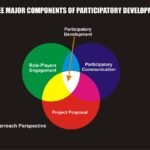
The conceptual structure of Farreach Theory is inspired by the additive theory of colour mixing.
Farreach Theory establishes that participatory communication, role-player engagement, and project proposal are the three major components of participatory development that significantly influence the outcome of development interventions.
Just as the human eye recognises three primary colours—red, green, and blue—as the foundation of visible light, Farreach Theory recognises participatory communication, role-player engagement, and project proposal as the foundational components that influence participatory development outcomes.
When these three components are effectively integrated into a development intervention, they enhance the likelihood of achieving the project’s objectives and generating sustainable impact.
Conversely, when one or more of these components are weak, absent, or poorly implemented, the likelihood of project failure increases significantly.
Within the visual representation of Farreach Theory:
- Blue represents Participatory Communication.
- Green represents Role-Player Engagement.
- Red represents Project Proposal.
The intersection of these three colours produces white light, which symbolises Participatory Development.
The black background represents the development challenges that participatory development seeks to address.
As the intensity of the white light increases, the darkness recedes. Symbolically, this represents how effective participatory development interventions can transform challenging conditions and improve human well-being.
The white circle enclosed by a black ring represents the Farreach Theory itself—a framework that seeks to illuminate pathways towards more inclusive, effective, and sustainable development outcomes.
Upon these premises stands Farreach Theory.
The practical application and detailed explanation of the theory are presented in my journal article, Using Participatory Communication for Effective Role-Players Engagement: Farreach Perspective (Dikeocha, 2024), published in the Annals of the International Communication Association.
The Contribution of Farreach Theory: Filling a Gap in Participatory Development
As my research progressed, an important question emerged:
If participatory development, Development Communication, and stakeholder engagement have been studied for decades, why is Farreach Theory necessary?
The answer lies in what I perceived as a conceptual and operational gap within the existing literature and practice of participatory development.
Numerous scholars and practitioners have made significant contributions to our understanding of participation, communication, stakeholder engagement, project management, and social change. These contributions have advanced the field considerably and provided valuable foundations upon which Farreach Theory was developed.
However, I observed that many existing approaches tend to focus primarily on one aspect of participatory development rather than providing a framework that explains the interaction among the three major components that influence participatory development outcomes: participatory communication, role-player engagement, and project proposal.
Farreach Theory was therefore developed to provide an integrated framework that explains the relationship among these three components and their collective influence on development outcomes. It measures development by analyzing Reach (who is included), Depth (how much agency do they have), and Systemic Influence (does local knowledge actually change high-level policies).
Farreach Theory and Participatory Rural Appraisal (PRA)
Participatory Rural Appraisal (PRA), pioneered by scholars such as Robert Chambers, transformed development practice by encouraging communities to become active participants in analysing their own realities and identifying solutions to local challenges.
Farreach Theory shares PRA’s commitment to participation and local knowledge. However, while PRA primarily provides a set of participatory tools and techniques for community engagement, Farreach Theory seeks to provide a broader conceptual framework for understanding how participation, communication, and project design interact throughout the entire development process.
In this sense, PRA offers practical methods for participation, whereas Farreach Theory seeks to explain the underlying relationships that make meaningful participation effective and sustainable.
Farreach Theory and Communication for Development
Communication for Development has contributed significantly to understanding the role of communication in social change and development interventions. It has been demonstrated that communication is not merely the transmission of information but an essential process for dialogue, learning, mobilisation, and collective action.
Farreach Theory builds upon these insights but argues that communication alone cannot fully explain development outcomes.
Effective communication must operate alongside meaningful role-player engagement and a project proposal that intentionally incorporates participatory principles. Farreach Theory therefore places communication within a broader framework that recognises the interdependence of communication, people, and project design.
Farreach Theory and Stakeholder Theory
Stakeholder Theory has provided valuable insights into the identification, analysis, and management of stakeholders within organisations and projects. It highlights the importance of recognising the interests and influence of different actors and incorporating their perspectives into decision-making processes.
Farreach Theory shares this concern for inclusion and engagement. However, it extends beyond stakeholder identification and management by emphasising continuous role-player engagement throughout the life cycle of a participatory development intervention.
Farreach Theory also places particular emphasis on the core beneficiaries of development interventions, arguing that they should occupy a central position within participatory development because they are the primary reason development interventions exist.
The Distinct Contribution of Farreach Theory
The unique contribution of Farreach Theory lies not in replacing existing approaches but in integrating insights from multiple traditions into a single framework.
Farreach Theory proposes that sustainable participatory development outcomes are influenced by the effective interaction of three foundational components:
- Participatory Communication
- Role-Player Engagement
- Project Proposal
The theory seeks to explain how these components intersect, reinforce one another, and collectively influence the success or failure of development interventions.
In this regard, Farreach Theory complements rather than competes with existing approaches. It draws from their strengths while providing an integrated framework that connects communication, participation, and project design within a single participatory development model.
It is this integration that constitutes the central contribution of Farreach Theory to the ongoing evolution of participatory development theory and practice.
Presenting Farreach Theory to the Academic Community and the World (2017–2024)
On March 18, 2024, I stood upon the shoulders of giants—Paulo Freire, Robert Chambers, Jan Servaes, Thomas Tufte, and many other scholars whose works helped shape my intellectual journey—to present the Farreach Theory to the academic community and the wider public.
The theory was formally introduced through my journal article, Using Participatory Communication for Effective Role-Players Engagement: Farreach Perspective (Dikeocha, 2024), published in the Annals of the International Communication Association.
The publication of that article marked a historic milestone in the evolution of Farreach Theory, Farreach International, and what would later become the FarreachOne Toolkit.
The achievement, however, was not the result of a straightforward journey. It was the outcome of years of research, sacrifice, persistence, uncertainty, prayer, and unwavering conviction.
The Research Journey Begins
In January 2017, I officially committed myself to the development of Farreach Theory as a full-time research project.
I devoted more than ninety per cent of my available time, energy, and resources to the work.
The project demanded extensive reading, critical reflection, comparative analysis, and continuous refinement of ideas. I gathered research materials from multiple sources and studied more than one hundred development projects implemented across various African countries between 2001 and 2017.
After applying the criteria established for the study, only forty-eight projects met the requirements for inclusion in the research.
The process was rigorous and often exhausting, but it provided the empirical foundation upon which Farreach Theory was built.
By December 2018, I had completed the first draft of the manuscript.
Throughout 2019, I worked extensively on the second and third drafts, refining the theoretical arguments, strengthening the analysis, and improving the overall structure of the paper.
A Defining Spiritual Experience
While working intensively on the third draft in August 2019, I experienced what I consider one of the defining moments of the entire journey.
Throughout that month, I repeatedly sensed the Holy Spirit impressing upon my heart that the publication of the manuscript and the eventual launch of the FarreachOne platform would mark the beginning of a new era within the international development sector and that Farreach International would play a significant role in that emerging future.
The message came repeatedly during periods of prayer, reflection, and deep spiritual communion.
As a Christian, I believe in the Trinity and in the ministry of the Holy Spirit. Throughout my life, I have sought to walk closely with Him and to remain attentive to His guidance.
I often describe the Holy Spirit as my Senior Partner because His guidance has influenced many of the most important decisions I have made.
The conviction I received during that period strengthened my resolve to continue despite the uncertainties that lay ahead.
Seeking Expert Review
In February 2020, I submitted the manuscript to three experts within my field of study for review and feedback.
I expected constructive criticism that would strengthen the manuscript before its submission to an international journal.
Three months passed without any feedback.
When I eventually followed up, one reviewer explained that serious health challenges had prevented him from undertaking the review. The other two requested that I resend the manuscript because they could no longer locate the original copies.
I gladly complied.
Having already revised the manuscript during the waiting period, I submitted an improved version to them.
Again, several months passed without meaningful feedback.
When I contacted them a second time, it became apparent that none of them had reviewed the manuscript.
Although disappointed, I recognised that the responsibility for moving the work forward ultimately rested with me.
I decided to undertake another comprehensive review of the manuscript myself and prepare it for submission to an international academic journal.
Overcoming the Fear of Rejection
Beginning in September 2020, I started searching for a suitable international journal.
The decision was more difficult than many people might imagine.
At the time, I was neither a PhD holder nor a university lecturer. My Master’s degree programme in Communication Studies remained incomplete because of financial constraints. Although I had previously published research papers in international journals, I still found myself wrestling with a significant fear of rejection.
I understood how academic publishing worked.
I knew that many manuscripts are rejected before they even reach peer review.
The possibility of a desk rejection weighed heavily on me.
Adding to that challenge was my own tendency toward perfectionism. I continually questioned whether the manuscript was sufficiently strong, whether the argument was clear enough, and whether the theory would be taken seriously.
The struggle became both academic and personal.
Then, in the early hours of December 4, 2020, after a period of prayer and reflection, I sensed a clear conviction that it was time to let the manuscript go.
By the grace of God, I overcame my fears.
On December 4, 2020, I submitted the manuscript to an international academic journal.
The First Peer-Review Process
Two weeks later, I received encouraging news.
The Editor-in-Chief informed me that the manuscript had passed the initial screening process and had been sent to two peer reviewers for evaluation.
I was excited.
For the first time, independent experts would critically examine the work and determine whether it made a meaningful contribution to the field.
In February 2021, the reviewers’ comments arrived.
I carefully addressed every concern, responded to every question, and revised the manuscript accordingly. Four weeks later, I resubmitted the revised version.
Several months later, additional comments arrived.
Once again, I worked through each recommendation and strengthened the manuscript further before submitting a second revised version in September 2021.
At that stage, I felt optimistic.
The manuscript had survived multiple rounds of peer review and had improved substantially through the process.
The Long Silence
After submitting the second revised manuscript, I expected a final editorial decision within a few months.
Instead, silence followed.
Weeks became months.
Months became a year.
I checked my email constantly, hoping for news from the journal.
None came.
In March 2022, after waiting five months without communication, I wrote to the Editor-in-Chief requesting an update on the status of my manuscript.
No response arrived.
Two months later, I wrote again.
Still no response.
Eventually, I contacted the Administrative Editor of the journal.
To my relief, he replied within a few days. He informed me that both reviewers had submitted their reports and that the manuscript was awaiting a final decision from the Editor-in-Chief.
Although the response offered some reassurance, the waiting continued.
Throughout the remainder of 2022, no final decision was communicated.
A Difficult Decision
By early 2023, I faced a difficult choice.
Should I continue waiting indefinitely, or should I withdraw the manuscript and risk beginning the peer-review process again with another journal?
The decision was not easy.
Years of work had already been invested in the manuscript.
Starting over meant accepting uncertainty, additional delays, and the possibility of rejection.
After much reflection and prayer, I became convinced that withdrawing the manuscript was the correct decision.
On February 10, 2023, I formally requested its withdrawal.
The Administrative Editor responded and cautioned me about the risks of restarting the peer-review process elsewhere.
I appreciated his concern, but my decision had already been made.
The withdrawal request was approved.
The manuscript was released.
And once again, I found myself standing at the beginning of a new journey.
A New Submission and a Historic Breakthrough
After adapting the manuscript to the style and requirements of a new journal, I submitted it on March 8, 2023, to the Annals of the International Communication Association.
The decision was ambitious.
The journal is recognised as one of the leading journals in communication studies and occupies a significantly higher academic ranking than the journal from which I had withdrawn the manuscript.
Within two weeks, I received confirmation that the manuscript had been sent for peer review.
The process moved efficiently.
When the reviewers’ reports arrived, I addressed every comment carefully and resubmitted the revised manuscript.
Several months later, further revisions were requested.
Once again, I responded comprehensively and resubmitted the manuscript on September 23, 2023.
Then came the moment I had prayed for, worked for, and waited years to see.
On November 13, 2023, I received an email from the Editor-in-Chief informing me that the manuscript had been accepted for publication.
I was overwhelmed.
The years of research, the uncertainty, the revisions, the delays, the setbacks, and the sacrifices had finally produced the breakthrough.
I wept tears of gratitude to God.
What had begun as an observation during a development project survey in 2007 had matured into a scholarly contribution to the field of international development and communication.
On March 18, 2024, the article was officially published online in the Annals of the International Communication Association.
With that publication, Farreach Theory entered the academic literature and was formally presented to the world.
It was not the end of the journey.
It was the beginning of a new chapter.
The Development and Launch of the FarreachOne (2023–2025)
On March 18, 2025, exactly one year after the public presentation of Farreach Theory, I had the privilege of presenting the FarreachOne to the world.
Just as Farreach Theory emerged from a desire to improve the theory and practice of participatory development, the FarreachOne emerged from a desire to transform theory into practice.
The platform was inspired directly by the Farreach Theory and Framework. It was conceived as a practical solution for applying the principles, models, and tools developed through the research behind Farreach Theory. My vision was to automate these tools within a web-based software platform that development practitioners, researchers, governments, donor agencies, civil society organisations, and communities could easily access and use.
The FarreachOne represented a significant shift in my thinking.
Farreach Theory had provided a conceptual framework for understanding the relationship among participatory communication, role-player engagement, and project proposal. However, I recognised that for the theory to achieve meaningful impact, practitioners needed practical tools that could support implementation in real-world development settings.
The development of the FarreachOne was therefore an effort to bridge the gap between theory and practice.
The Early Development Challenges
Work on the FarreachOne began in February 2023.
At the time, I worked closely with my Technical Assistant on the project. We shared a common desire to see the vision become a reality. However, despite our commitment, progress was much slower than I had anticipated.
Several factors contributed to the delays.
Financial resources were extremely limited. Reliable electricity was often unavailable. We worked from different locations and relied heavily on remote communication. In many cases, months would pass before I received substantial updates regarding the project’s progress.
Even when I communicated through SMS, email, or WhatsApp, responses were sometimes delayed because my Technical Assistant was simultaneously engaged in other software development projects.
I understood his situation.
He was not employed as a paid developer on the project. Rather, he was assisting me as a friend and collaborator.
In fact, there were occasions when I attempted to compensate him financially for his efforts, but he declined and returned the money.
Our friendship stretched back to 2014, and we had successfully collaborated on other projects over the years. His willingness to support the vision despite the challenges remains something I deeply appreciate.
Nevertheless, I became increasingly concerned about the pace of development.
Given the amount of time invested in the project, I felt that the progress being made was insufficient to achieve the objectives I had set.
Perhaps my concerns became evident.
Around March 2024, my Technical Assistant informed me that he no longer wished to continue with the project. He explained that he did not want to be responsible for slowing down the development of the FarreachOne.
With that decision, I suddenly found myself alone.
The project remained alive, but the technical support upon which I had depended was no longer available.
A New Decision
At that moment, I faced another crossroads.
Hiring a professional software developer was beyond my financial capacity. The resources required simply did not exist.
I had two choices.
I could postpone the vision indefinitely while waiting for funding or technical assistance, or I could learn the skills necessary to continue the work myself.
I chose the second option.
Although I had little formal knowledge of programming, software engineering, or web application development, I believed that with determination, discipline, and God’s help, I could learn enough to move the project forward.
Learning to Build
In May 2024, I enrolled in a Web and App Development programme at the Oluaka Institute of Technology in Owerri, Imo State, Nigeria.
The programme was designed for beginners and provided foundational training in web and application development.
For me, it was more than a training programme.
It was the beginning of an entirely new journey.
I approached the learning process with the same intensity and commitment that I had applied to the development of Farreach Theory.
After completing the programme in August 2024, I enrolled in additional online courses to deepen my understanding of software and web development.
The more I learned, the more confident I became.
Gradually, the belief that I could personally contribute to the development of the FarreachOne began to grow.
Building Through Practice
In December 2024, I embarked on another important project—the development of a new website for Farreach International.
That experience became a practical training ground.
Building the website exposed me to new technologies, new problem-solving approaches, and new technical skills. Every challenge became an opportunity to learn.
Every obstacle became a lesson.
The process strengthened my confidence and reinforced my conviction that the FarreachOne could become a reality.
By January 2025, I was ready.
I officially began the development of the FarreachOne.
From that point forward, I committed myself fully to the project.
I devoted substantial time and effort to learning, experimenting, testing, troubleshooting, and building.
The journey was not without challenges.
There were moments of frustration.
There were technical problems that seemed impossible to solve.
There were periods when progress felt painfully slow.
Yet every challenge eventually became an opportunity to learn something new.
By the grace of God, solutions always emerged.
The support of online developer communities also proved invaluable. Participating in software development forums, engaging with developers around the world, and building relationships through platforms such as GitHub provided encouragement and practical assistance whenever I encountered difficulties.
Those communities became part of the unseen support system behind the project.
The Public Launch
On March 18, 2025, exactly one year after the publication of Farreach Theory, the FarreachOne was officially presented to the public.
The moment carried profound significance.
It represented far more than the launch of a software application.
It symbolised the successful transition of Farreach from theory to implementation.
What began as an observation during a development project survey in 2007 has evolved into a theoretical framework, a body of research, and now a digital platform designed to support participatory development practice.
For me, the launch was both a milestone and a beginning.
The platform demonstrated that Farreach Theory was not merely an academic contribution. It could also be translated into practical tools capable of supporting development practitioners and organisations in their daily work.
Looking Beyond the Launch
The launch of the FarreachOne marked the completion of one phase of the journey.
It also marked the beginning of another.
The next task before us is the continued development of the Farreach ecosystem and the building of a multidisciplinary Farreach Team capable of advancing research, innovation, technology development, and implementation.
The vision extends far beyond a theory or a software platform.
The vision is to contribute meaningfully to a new era of participatory development—one that places people at the centre, strengthens communication, improves project design and implementation, and creates sustainable impact across Africa and beyond.
That journey is still unfolding.
And we are only just beginning.
Why Farreach Matters Today
The twenty-first century has witnessed remarkable advances in science, technology, healthcare, education, and economic development. Yet despite these achievements, many of the world’s most pressing development challenges remain unresolved.
Across Africa, Asia, Latin America, the Middle East, Europe, North America, and the Pacific, governments, donor agencies, international organisations, civil society organisations, researchers, and development practitioners continue to invest billions of dollars annually in programmes designed to improve human well-being.
These interventions address a wide range of issues, including poverty reduction, food security, climate change, public health, education, gender equality, governance, peacebuilding, humanitarian response, social inclusion, and sustainable development.
While many of these efforts have produced meaningful results, the international development sector continues to face persistent challenges.
Development projects sometimes fail to achieve their intended objectives. Communities occasionally resist or reject interventions designed to benefit them. Stakeholder conflicts emerge during implementation. Project outcomes are not always sustained after external funding ends. In some cases, the voices of those most affected by development challenges are insufficiently reflected in decisions intended to improve their lives.
These challenges are not confined to any single country, region, institution, or sector. They represent global concerns that continue to shape discussions about the future of development practice.
At the same time, the world is becoming increasingly interconnected and complex.
Development interventions now operate within environments characterised by multiple stakeholders, competing interests, cultural diversity, rapid technological change, political uncertainty, environmental pressures, and growing demands for transparency, accountability, and citizen participation.
As a result, development practitioners increasingly recognise that technical expertise and financial resources alone are often insufficient to guarantee sustainable outcomes.
People matter.
Relationships matter.
Communication matters.
Participation matters.
Farreach Theory emerged from this reality.
The theory is built on a simple but powerful proposition: sustainable development outcomes are more likely when participatory communication, meaningful role-player engagement, and effective project design are intentionally integrated throughout the development process.
Farreach Theory seeks to contribute to ongoing global efforts to improve the effectiveness, inclusiveness, and sustainability of development interventions by providing a framework that helps practitioners better understand the relationship among these three foundational components.
The theory does not claim to provide a universal solution to every development challenge. Rather, it offers a lens through which governments, donor agencies, international organisations, civil society groups, researchers, consultants, and communities can better understand and strengthen participatory development processes.
Its relevance extends beyond traditional development projects.
The principles of Farreach Theory can be applied to community development initiatives, climate adaptation programmes, humanitarian interventions, public health campaigns, governance reforms, peacebuilding efforts, social innovation initiatives, organisational change processes, and other contexts where diverse role-players must work together to address complex challenges.
The growing global emphasis on localisation, inclusion, participation, community ownership, and sustainable impact further highlights the importance of frameworks that help strengthen relationships between people, communication processes, and development interventions.
Farreach Theory, therefore, represents an effort to contribute to a broader global conversation about how development can become more inclusive, more participatory, more responsive, and ultimately more effective.
The FarreachOne Toolkit extends this vision by providing practical digital tools designed to support the application of these principles in real-world settings.
Together, Farreach Theory and the FarreachOne Toolkit seek to bridge the gap between theory and practice, helping practitioners move beyond participation as an aspiration towards participation as a structured and measurable component of development practice.
In an increasingly complex world, the future of development will depend not only on what solutions are implemented, but also on how those solutions are designed, communicated, owned, and sustained.
It is within this context that Farreach Theory seeks to make its contribution.
The Emerging Farreach Ecosystem
The Farreach vision has gradually evolved into an ecosystem consisting of interconnected institutions, platforms, and initiatives.
The major components of the ecosystem currently include:
- Farreach Framework (Farreach Theory and Method)
- FarreachOne
- Farreach International Ltd.
- Farreach Initiative for Development Communication in Africa, Inc.
- Farreach Labs (Future research, training, certification, consulting, and technology programmes)
Together, these components provide the foundation for a comprehensive ecosystem dedicated to advancing participatory development, development communication, and social innovation in Africa and beyond.
Looking Towards 2035
My vision is to see Farreach Theory recognised as a leading framework for participatory development, FarreachOne established as a globally accessible platform for role-player engagement and participatory communication, and the Farreach ecosystem serving governments, development agencies, researchers, universities, and communities across Africa and beyond.
I envision a future where development interventions are increasingly designed with people rather than merely for people, where participation becomes a standard rather than an option, and where technology strengthens inclusive decision-making and sustainable impact.
The journey has begun, but the vision extends far beyond the achievements recorded in this history.
An Invitation to Collaborate: Advancing the Farreach Vision
Farreach Theory and the FarreachOne Toolkit represent the beginning of a broader journey rather than its final destination.
Like many innovations in international development, the true value of the Farreach Framework can only be fully understood through practical application, testing, learning, adaptation, and continuous improvement in real-world settings.
While the publication of Farreach Theory and the launch of the FarreachOne Toolkit mark important milestones, significant work remains to be done. The framework requires further validation through pilot projects, implementation research, case studies, independent evaluations, and collaborative learning across different countries, sectors, and development contexts.
For this reason, Farreach International and Farreach Initiative for Development Communication in Africa welcome opportunities to collaborate with governments, development agencies, donor organisations, universities, research institutions, foundations, civil society organisations, community-based organisations, technology partners, and private-sector institutions interested in advancing participatory development practice.
We are particularly interested in partnerships that support:
- Pilot testing and validation of Farreach Theory.
- Field implementation and testing of the FarreachOne Toolkit.
- Joint research and publication initiatives.
- Monitoring, evaluation, and learning studies.
- Capacity-building and training programmes.
- Technology development and platform enhancement.
- Community engagement and participatory development projects.
- Climate adaptation, governance, health, education, agriculture, and social development initiatives.
- Cross-country learning and knowledge-sharing programmes.
- Resource mobilisation and ecosystem development.
We believe that meaningful innovation in international development is best achieved through collaboration. No single organisation, institution, or individual possesses all the knowledge, resources, or experience required to address the complex challenges facing communities around the world.
The Farreach vision, therefore, embraces partnership as a foundational principle.
As Farreach Theory continues to evolve and the FarreachOne Toolkit expands, we invite researchers, practitioners, policymakers, development professionals, philanthropists, investors, and institutions to join us in exploring how participatory communication, role-player engagement, and effective project design can contribute to more inclusive, sustainable, and impactful development outcomes.
The future of Farreach will not be built by one individual or one organisation alone.
It will be shaped by a global community of partners committed to advancing participation, strengthening collaboration, and improving the effectiveness of development interventions for the benefit of communities everywhere.
The journey continues, and we welcome those who share this vision to become part of it.
Future Research Directions
- Comparative studies of Farreach and PRA.
- Validation studies across sectors.
- Cross-country applications.
- Measurement of role-player engagement.
- Development of Farreach indicators.
- Integration with digital participation platforms.
- Application in humanitarian settings.
- Application in climate adaptation programmes.
- Application in governance and public policy.
Lessons from the Farreach Journey
I learnt that:
- Great ideas often emerge from ordinary experiences.
- Complex problems require patience and long-term thinking.
- Research and innovation are marathons, not sprints.
- Mentorship matters.
- Rejection and delays are often part of the process.
- Resource constraints do not necessarily prevent innovation.
- Faith, perseverance, and conviction are critical when pursuing difficult goals.
The Farreach Declaration
We believe:
- Development should be done with people, not merely for people.
- Every voice deserves a listening ear.
- Participation is a process, not an event.
- Communication is central to sustainable development.
- Communities should be active partners in shaping their futures.
- Development interventions should promote ownership, inclusion, and sustainability.
- Technology should strengthen participation rather than replace it.
- Meaningful engagement produces stronger outcomes.
Milestones in the History of Farreach
Year | Milestone |
2007 | Development project survey in Imo State; conception of the Farreach idea |
2009 | First draft of Shadows of Development |
2015 | Mentorship period and beginning of consulting career |
2016 | Registration of Farreach Media |
2017 | Registration of Farreach Initiative and commencement of Farreach Theory research |
2018 | First draft of Farreach Theory manuscript completed |
2020 | Submission to first international journal |
2023 | Submission to Annals of the International Communication Association |
Nov 2023 | Manuscript accepted |
Mar 18, 2024 | Farreach Theory published |
Mar 18, 2025 | FarreachOne Toolkit launched |
2026+ | Validation, scaling, and ecosystem development |
Acknowledgements
I acknowledge with profound gratitude the scholars whose works shaped my intellectual journey, particularly Paulo Freire, Robert Chambers, Jan Servaes, Thomas Tufte, Paolo Mefalopulos, Alfonso Gumucio Dagron, and many others whose contributions advanced the field of participatory development and development communication.
I also acknowledge Dr. Chuks Osuji for his encouragement and support during the formative years of my research and consulting career.
I remain grateful to my parents, family members, friends, colleagues, and everyone who supported the Farreach vision at different stages of its development.
Above all, I give glory to God Almighty and acknowledge the guidance of the Holy Spirit throughout this journey.
Conclusion: From an Observation in 2007 to a Global Vision for Participatory Development
Today, I am delighted to share the brief history of Farreach Theory, Farreach International, and the FarreachOne Toolkit.
What began in 2007 as a simple assignment to survey development projects in Imo State, Nigeria, became the seed of a journey that I could never have fully imagined at the time.
That experience exposed me to realities that challenged many of my assumptions about development. It revealed both the possibilities and limitations of development interventions. More importantly, it ignited a series of questions that would shape the direction of my academic, professional, and entrepreneurial journey for years to come.
The questions were simple, yet profound:
Why do some development projects succeed while others fail?
Why do communities sometimes reject interventions designed to improve their well-being?
Why do significant investments in development often fail to produce sustainable outcomes?
And what can be done differently?
For nearly two decades, these questions guided my studies, professional experiences, research activities, and reflections. They inspired the development of Farreach Theory, influenced the establishment of Farreach International and the Farreach Initiative for Development Communication in Africa, and ultimately led to the creation of the FarreachOne Platform.
Farreach Theory emerged from a conviction that participatory development can be strengthened through the effective integration of three foundational components: participatory communication, role-player engagement, and project proposal. The theory provides a framework for understanding how these components interact and how their effective application can contribute to more inclusive, sustainable, and impactful development outcomes.
The publication of the research article, Using Participatory Communication for Effective Role-Players Engagement: Farreach Perspective (Dikeocha, 2024), marked an important milestone in the formal presentation of the theory to the academic community and the wider public. It represented the culmination of years of research, learning, persistence, and faith.
Yet, the publication of Farreach Theory was never intended to be the final destination.
From the beginning, my desire was to see the theory translated into practical tools that could support development practitioners, governments, donor agencies, civil society organisations, researchers, and communities in their daily work.
That vision gave birth to the FarreachOne platform.
The development and launch of the toolkit represented an important transition from theory to practice. It transformed concepts into tools, ideas into systems, and research into a practical platform designed to support participatory development interventions.
Together, Farreach Theory and the FarreachOne form two complementary dimensions of the Farreach vision.
The theory provides the conceptual foundation.
The toolkit provides the implementation platform.
However, the broader vision extends beyond both.
Farreach International was established to serve as a platform for research, innovation, consulting, capacity development, technology development, and strategic partnerships that advance the application of the Farreach Framework across different sectors and contexts.
Looking ahead, the next phase of the journey is clear.
Farreach Theory must continue to be tested, refined, and strengthened through further research and practical application.
The FarreachOne must continue to evolve into a robust digital platform capable of supporting participatory development initiatives across Africa and beyond.
Farreach International must continue building the partnerships, institutions, technologies, and multidisciplinary teams necessary to advance this vision on a larger scale.
The ultimate goal is not simply to promote a theory, build a software platform, or establish an organisation.
The goal is to contribute meaningfully to a more inclusive, participatory, and effective approach to development—one in which people are genuinely placed at the centre of decisions that affect their lives.
I believe that sustainable development becomes more achievable when development interventions are designed with people rather than merely for people.
I believe that communication is most powerful when it creates opportunities for listening, dialogue, collaboration, and shared ownership.
I believe that development projects produce greater impact when role-players are meaningfully engaged throughout the entire project cycle.
And I believe that the future of participatory development lies in our collective ability to bridge theory and practice, research and implementation, innovation and inclusion.
The story of Farreach is therefore still being written.
Farreach Theory has been presented.
FarreachOne has been launched.
Farreach International continues to grow.
The next chapter will be shaped by the researchers, practitioners, institutions, communities, governments, donor agencies, and development partners who choose to join us in advancing this vision.
What began as an observation in a rural community in Nigeria has grown into a vision that reaches far beyond geographical boundaries.
The journey continues.
And the best chapters may still lie ahead.
About the Author
Chijioke Dikeocha is a development communication researcher, social innovator, entrepreneur, and founder of Farreach International. He is the creator of the Farreach Theory (Framework) and the developer of the FarreachOne, a digital platform designed to support participatory communication, role-player engagement, and participatory development interventions.
His work focuses on advancing the theory and practice of Development Communication, International Development, and Participatory Development through research, innovation, technology, and institutional partnerships. His research interests include participatory communication, stakeholder engagement, development communication, social change, project design and implementation, and digital solutions for development practice.
In 2024, he introduced the Farreach Theory to the academic community and the general public through his peer-reviewed journal article, Using Participatory Communication for Effective Role-Players Engagement: Farreach Perspective, published in the Annals of the International Communication Association. The theory provides a framework for understanding the relationship between participatory communication, role-player engagement, and project proposals in achieving sustainable development outcomes.
Beyond his academic contributions, Chijioke has worked across research, consulting, publishing, communication, and technology development. He is committed to building innovative tools and institutions that strengthen inclusive participation and improve the effectiveness of development interventions in Africa and beyond.
Through Farreach International and the Farreach Initiative for Development Communication in Africa, he continues to advance research, capacity development, technology innovation, and strategic partnerships aimed at promoting more inclusive, participatory, and sustainable development practices globally.
Connect with Farreach
- Farreach International: https://farreachinternational.com
- Farreach Initiative: https://farreachinitiative.org
- FarreachOne: https://app.farreachinternational.com
- Email: partnerships@farreachinternational.com; info@farreachinternational.com
- Research Collaborations: research@farreachinternational.com; info@farreachinternational.com
- LinkedIn: [Farreach International]: https://www.linkedin.com/company/farreach-international
- Facebook: https://web.facebook.com/profile.php?id=100064091791288